
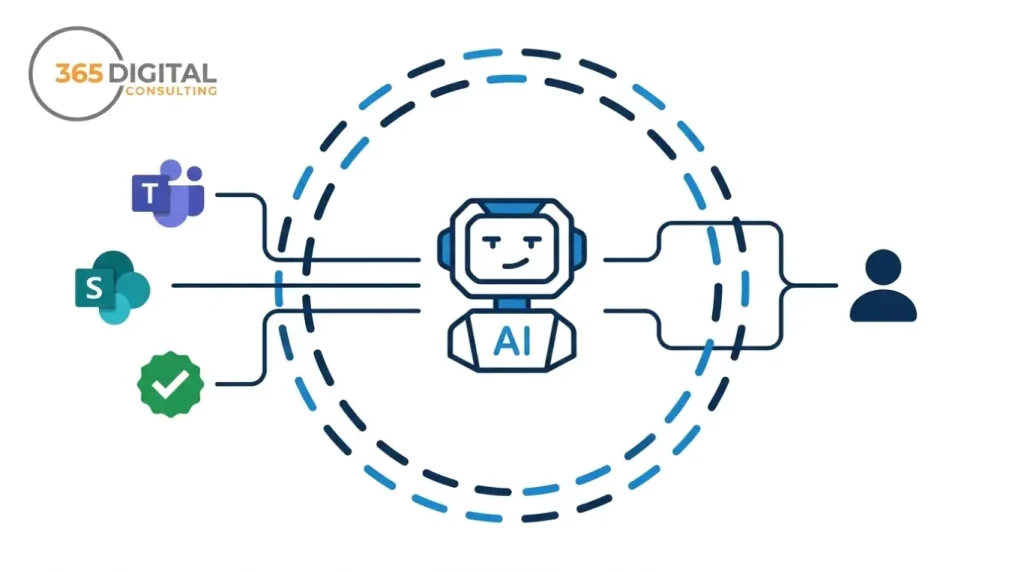
AI agent governance is the set of rules, boundaries, and oversight that decide what an AI agent is allowed to do, what data it can touch, and who reviews its actions, and it is the single biggest factor in whether a business can actually trust an agent with real work. Most companies can already build an agent that works in a demo. Far fewer have governance in place to let that agent run unsupervised against live customer data, live approvals, or live payroll. That gap is exactly why so many AI agent projects stall before they ever reach production.
This guide breaks down what makes an AI agent trustworthy, how to evaluate one before you deploy it, and the governance principles that separate a pilot that gets shelved from an agent that quietly saves a team hours every week.
Key Takeaways
More than 40% of agentic AI projects will be cancelled by the end of 2027 due to escalating costs, unclear value, and weak risk controls (Gartner, retrieved 2026-09-27).
Employee adoption of AI agents jumped from 23% to 56% in a single quarter, but only 59% of leaders say their organisation has the governance in place to manage the risk (KPMG, retrieved 2026-09-27).
A trustworthy AI agent is judged on four qualities: consistency, robustness, predictability, and safety, not just whether it gets the right answer once.
Governance is not a blocker to AI adoption; it is what makes scaling past the first pilot possible.
What Is AI Agent Governance?
AI agent governance is the practice of defining, in advance, what an AI agent can access, what actions it can take on its own, and what requires a human sign-off, then logging and reviewing what it actually does. It sits alongside AI agent security (protecting the agent and its data from misuse) and AI agent implementation (the technical build), but it is the layer that decides whether a business can hand an agent real authority rather than just read-only access.
Without governance, an agent is a demo. With it, an agent becomes a system a business can actually rely on for AI automation of timesheets, approvals, document processing, or customer service.
Why Trustworthy AI Agents Matter More Than Ever
Businesses are adopting AI agents faster than they are governing them, and the gap is showing up in the numbers. Gartner forecasts that agentic AI software spend will reach US$206.5 billion in 2026 and jump a further 82% to US$376.3 billion in 2027, yet the same research firm predicts that over 40% of agentic AI projects will be cancelled by the end of 2027 because of rising costs, unclear business value, and inadequate risk controls (Gartner, retrieved 2026-09-27).
The adoption side tells the same story. KPMG’s Q2 2026 AI Pulse survey of senior business leaders found that employee adoption of AI agents more than doubled in a single quarter, from 23% to 56%. But when asked whether their organisation had the capabilities and governance to manage the risks of scaling AI, security, privacy, ethics, compliance, and operational risk, only 59% of leaders agreed (KPMG, retrieved 2026-09-27). In practical terms: more than 4 in 10 leaders are scaling AI agents faster than they are scaling the controls around them.
That mismatch is the reason a Copilot AI readiness assessment usually pays for itself before a single agent is built, it forces the governance conversation to happen before the automation, not after something goes wrong.
The Four Qualities of a Trustworthy AI Agent
A trustworthy AI agent is not simply one that produces a correct answer. It is one that keeps producing the right outcome, inside the right boundaries, every time. Four qualities determine that:
- Consistency: the agent behaves the same way across similar requests, instead of handling the same type of ticket differently depending on phrasing.
- Robustness: it degrades gracefully on unexpected or malformed input rather than acting on a bad guess.
- Predictability: its decisions stay inside a defined, explainable range; nobody should be surprised by what it is allowed to do.
- Safety: when it does get something wrong, the blast radius is small and the mistake is recoverable, ideally before it reaches a customer or a financial system.
These qualities are exactly what Microsoft’s own Cloud Adoption Framework points to when it recommends that every agent meet a governance and security baseline before it is allowed to operate in production (Microsoft Learn, retrieved 2026-09-27), the same principle behind how we scope AI agent security and governance on every Microsoft 365 and Azure engagement.

How to Evaluate an AI Agent Before You Trust It With Real Work
Evaluating an AI agent for business use means looking past the demo and asking four questions:
| Evaluation area | What to check | Why it matters |
|---|---|---|
| Results | Does it complete the task and hit the intended business outcome, not just produce plausible-looking output? | A confident wrong answer is worse than no answer. |
| Process | Does it follow the approved workflow, use only the tools and data it’s scoped to, and respect existing policy? | An agent that gets the right result the wrong way is a compliance risk waiting to surface. |
| Decision quality | Are its actions based on current, correct data and the actual business rules, not a stale snapshot or a guessed rule? | Bad inputs produce confidently bad decisions at machine speed. |
| Reliability | Does performance hold up across repeated use, edge cases, and busier-than-usual periods? | A pilot that works for 20 tickets can still fail at 2,000. |
Track this with concrete measurements, not gut feel: task success rate, error rate, response time, cost per completed task, and, critically, how cleanly the agent recovers when it does fail. That last measure is often the best predictor of whether an agent is ready to move from pilot to production.
Principles for Building Dependable, Governed AI Agents
Reliable agents are designed for the failure case, not just the happy path.
1. Define clear boundaries. Give the agent only the systems, data, and actions it need, nothing more. This means scoping role-based access per agent, aligning permissions with existing IT security policy, and writing down explicitly what the agent can and cannot do before it goes live, not after.
2. Add strong safeguards. Define the approved list of actions and tools an agent can use, require human approval for anything financial, irreversible, or customer-facing, and add extra checks around high-impact workflows like payroll or contract approvals.
3. Maintain visibility and accountability. Log every meaningful action an agent takes, keep those logs for audit and compliance review, and make sure someone on the team can explain why the agent did what it did, not just what it did.
4. Keep humans in the loop. Pilot before you scale, monitor performance continuously once live, and build in a fallback path so a human can pick up any request the agent shouldn’t handle alone.
This is the same structure behind secure AI agent design and AI agent governance on Microsoft 365: agents run inside the organisation’s own tenant where possible, respect existing role-based access control, and are scoped so it is always clear what data an agent can and cannot see, consistent with a business’s existing Microsoft Teams governance framework rather than sitting outside it.

What This Looks Like Inside Microsoft 365
For businesses already running Microsoft 365, governed AI agents are usually built on three layers working together:
- Copilot Studio: the core platform for conversational AI agents that live inside Microsoft 365 and Teams, used for tasks like timesheet approvals, document triage, and internal Q&A. Our breakdown of Copilot Studio vs. Copilot explains where each fits.
- Azure AI Foundry & Agent Service: used for more complex workflows, high-volume document processing, and agents that need to search and reason over SharePoint content securely.
- MCP (Model Context Protocol): the secure connective layer that lets agents in Teams talk to line-of-business systems without exposing more data than they’re scoped for.
This is also where governance earns its keep as an SEO and trust signal in its own right: SharePoint permission sprawl is one of the most common reasons an agent ends up with access it shouldn’t have. Our case study on fixing SharePoint site sprawl shows what cleaning that up looks like in practice, and our article on Copilot Studio and secure AI workflows covers the build side in more depth. For the bigger picture on where agents fit next to Copilot itself, see From Copilot to AI Agents for Business Workflows.
Building Trust Step by Step
Trustworthy AI doesn’t arrive fully formed, it’s built in stages, and skipping a stage is usually where the 40% cancellation rate comes from.
- Discovery and value mapping. Identify the specific process, timesheets, approvals, document handling, customer service, where an agent offers the clearest, measurable ROI.
- Pilot on one workflow. Prove value in weeks, not months, on a single well-bounded task before expanding scope.
- Add governance and security before scaling. Lock in access boundaries, approval rules, and audit logging while the agent is still small enough to review closely.
- Scale and enable the team. Extend to more processes, introduce multi-agent orchestration where it’s genuinely needed, and train the team to own and monitor the agent ecosystem going forward.
Businesses that follow this order tend to end up with agents people actually trust with real tasks; those that skip straight to scale tend to end up as one of Gartner’s cancelled projects.
Frequently Asked Questions
What is the difference between AI agent governance and AI agent security? AI agent security protects the agent itself and the systems it touches from misuse, unauthorised access, or exploitation. AI agent governance is the broader layer of policy: who owns which agent, what it’s allowed to decide on its own, and how its actions are reviewed. Security stops an agent from being attacked; governance stops an agent from quietly doing the wrong thing even when nobody attacks it.
How long does it take to build a trustworthy AI agent for a small or mid-sized business? Most engagements start with a scoped pilot, for example, a single timesheet-approval or document-processing agent,running in weeks rather than months. Governance and security controls are layered in during that pilot, so by the time it’s proven, the agent is already operating inside the right boundaries rather than needing a retrofit.
Can an AI agent work safely with sensitive documents or financial data? Yes, provided the boundaries are set correctly from the start: the agent should run inside the business’s own Microsoft 365 or Azure tenant where possible, inherit existing role-based access control, and have every action logged for review. Sensitive workflows, payroll, contracts, financial approvals, should also require human sign-off rather than fully autonomous action.
What happens when an AI agent makes a mistake? In a properly governed setup, the impact is contained by design: the agent’s scope limits how much damage a single error can cause, the action is logged, and a human can review and reverse it. This is why safety and recoverability, not just accuracy, are core measures of a trustworthy agent.
Do we need a formal AI governance framework before starting our first AI agent project? Not a full framework on day one, but you do need the basics decided before the pilot goes live: who owns the agent, what it can access, and who approves its higher-impact actions. A Copilot AI readiness assessment is typically the fastest way to get those decisions made before building anything, rather than governing retroactively after a pilot has already gone into production.
Bringing It Together
A dependable AI agent isn’t defined by a single impressive demo. It’s defined by consistent results, a process that respects existing rules, decisions grounded in the right data, and reliability that holds up over hundreds of repeat runs, all inside boundaries a business actually controls. 365 Digital Consulting works with Australian, UK, and Canadian businesses to build exactly that: AI agent implementation and business process automation on Microsoft 365 and Azure, governed from the first pilot rather than patched after the fact. If you’re weighing your first AI agent project, our team can walk through where the governance decisions need to happen, book a discovery call to start the conversation.


